

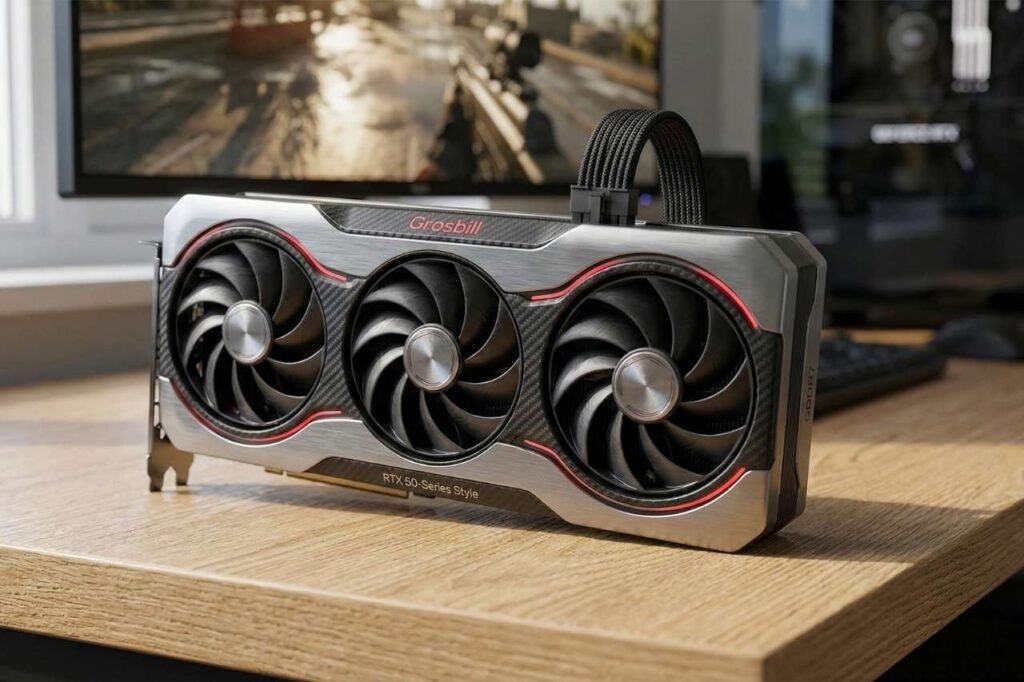
By 2026, a gaming PC’s performance will primarily depend on its graphics card. This component directly determines the visual quality and smoothness of your gaming sessions. Currently, three giants dominate the market: Nvidia with its RTX 50 series, AMD with its Radeon RX 9000 series, and Intel with its Arc Battlemage range. But how do you choose the right graphics card for your needs and budget? We’ll guide you toward the ideal solution for high-performance, affordable gaming.
Summary
What is a graphics card and why is it essential?
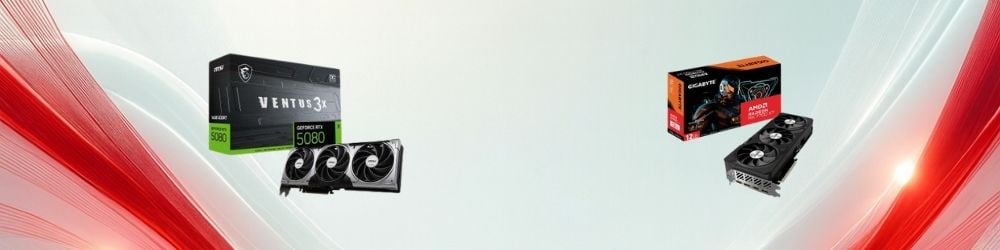
A graphics card handles visual calculations and displays images on your screen. Therefore, it’s the heart of your gaming experience. This component manages all 3D rendering, lighting effects, and high-definition textures. Furthermore, it frees up your central processing unit (CPU) from intensive graphics tasks.
Modern graphics cards now incorporate dedicated processors, called GPUs. These specialized chips perform thousands of operations simultaneously, thus ensuring high frame rates even in the most demanding games.
What are the differences between Nvidia, AMD, and Intel in 2026?
Nvidia and the Blackwell architecture (RTX 50)
Nvidia continues to dominate the high-end segment with its RTX 50 series. These graphics cards utilize the Blackwell architecture and offer DLSS 4.5, a revolutionary AI technology. Indeed, DLSS 4.5 delivers a 3- to 4-fold performance boost without compromising visual quality. Furthermore, AI-generated image rendering now achieves impressive fluidity.
The RTX 5070, RTX 5080, and RTX 5090 models feature ultra-fast GDDR7 memory. As a result, these graphics cards excel at 4K and even native 8K resolution. However, their price remains high, with the RTX 5090 exceeding €2,000. Nevertheless, for demanding gamers, the investment is fully justified.
AMD Radeon RX 9000: The price-performance ratio
AMD offers an attractive alternative with its Radeon RX 9000 series. These graphics cards are based on the RDNA 4 architecture and FSR 4, now enhanced with artificial intelligence. However, AMD maintains a more aggressive pricing strategy than Nvidia. As a result, gamers on a budget can find high-performance solutions with AMD.
The RX 9700 and RX 9800 XT series offer excellent performance at 1440p and 4K. Furthermore, these models include at least 12GB of GDDR7 VRAM. Consequently, they easily handle ultra textures and ray tracing games. However, their ray tracing is slightly less optimized than Nvidia’s.
Intel Arc Battlemage: the ambitious challenger
Intel is gradually establishing itself with its Arc B series (Battlemage). These graphics cards primarily target the mid-range market. Indeed, the Arc B770 and Arc B750 models compete with the RTX 5060 and RX 9600. Furthermore, Intel offers competitive upscaling technologies.
Intel’s main advantage lies in its attractive pricing. As a result, gamers can find high-performance graphics cards for under €400. However, some games still require driver optimizations to fully utilize the potential of these GPUs.
Dedicated graphics card vs. integrated graphics card: the match
An integrated graphics card shares system memory with the processor. Consequently, its performance remains limited for demanding gaming. On the other hand, it’s sufficient for office work and light multimedia. However, as soon as you launch a recent game, its limitations quickly become apparent.
A dedicated graphics card has its own VRAM and graphics processing unit (GPU). This allows it to handle visual calculations without slowing down your system. Furthermore, you can replace or upgrade it independently, so your PC can evolve according to your needs and budget.
Types of graphics cards:
- Dedicated graphics card: Independent component installed on a PCIe slot. It includes its own VRAM memory (minimum 12 GB in 2026) and offers maximum performance for gaming.
- Integrated graphics card: Integrated into the processor (iGPU). It shares system RAM and is only suitable for basic tasks or occasional gaming at 1080p low settings.
Which technologies will dominate graphics cards in 2026?
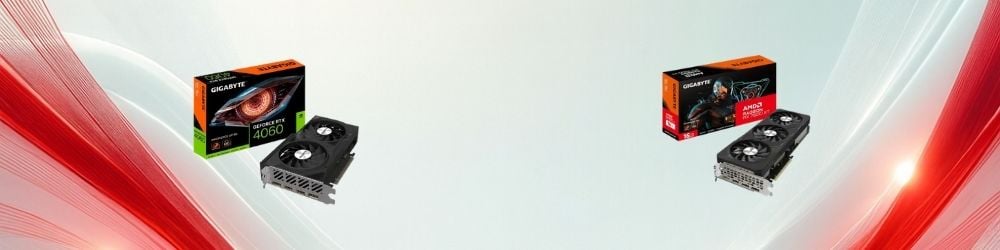
Modern graphics cards incorporate revolutionary technologies. First, ray tracing has become widespread across all product lines. Furthermore, AI-powered upscaling radically transforms performance. Finally, GDDR7 memory significantly increases available bandwidth.
Ray tracing: the ultimate visual immersion
Ray tracing simulates the real-world behavior of light in virtual environments. As a result, reflections, shadows, and lighting become more realistic. However, this technology requires significant graphics processing power. Therefore, recent graphics cards incorporate dedicated RT units to accelerate these calculations.
By 2026, even AAA games are widely adopting ray tracing. Furthermore, titles like Cyberpunk 2077 Ultimate Edition and The Witcher 4 fully utilize this technology. Therefore, investing in a compatible graphics card becomes essential to enjoy next-generation graphics.
DLSS 4.5 and FSR 4: AI at the service of performance
Nvidia’s DLSS 4.5 revolutionizes intelligent upscaling. This technology analyzes your images in real time and generates additional pixels. As a result, you get 4K performance while rendering at 1440p. Furthermore, the image generation artificially increases your frame rate.
AMD responds with FSR 4, now based on artificial intelligence. However, this solution remains open-source and works on all recent graphics cards. As a result, more gamers can benefit from upscaling without hardware limitations. Nevertheless, DLSS 4.5 retains a slight edge in image quality.
GDDR7: The memory that changes everything
GDDR7 memory is now standard in mid-range and high-end graphics cards. It offers 30% more bandwidth than GDDR6X. As a result, 4K and 8K textures load instantly. Furthermore, this memory consumes less power while delivering higher performance.
For gaming in 2026, aim for at least 12GB of VRAM. Recent games like Alan Wake 3 and GTA VI recommend this capacity. However, for 4K with maximum ray tracing, prioritize 16GB or more.
Overclocking: Boost your performance
Overclocking increases the operating frequency of your graphics card. As a result, you gain between 5 and 15% more performance. However, this practice requires adequate cooling and a stable power supply. Furthermore, modern graphics cards often offer factory overclocking profiles.
Advantages of overclocking:
- Free FPS boost in your favorite games
- Improved fluidity without additional investment
- Better utilization of resource-intensive titles
Use software like MSI Afterburner or AMD Adrenalin to overclock safely. This allows you to monitor temperatures and gradually adjust frequencies. However, remain cautious and respect the thermal limits of your graphics card.
How do you determine your graphics processing power needs?

Before buying your graphics card, clearly define your gaming goals. The target resolution directly influences the model you should choose. Furthermore, the desired framerate and graphics settings significantly alter the requirements.
1080p Gaming: The Effective Entry-Level Option
To play in Full HD (1920×1080), a mid-range graphics card is more than sufficient. For example, an RTX 5060 , an RX 9600, or an Arc B750 will deliver 60+ FPS in all current games. Furthermore, these models support ray tracing at medium settings. Therefore, you can enjoy the latest technologies without breaking the bank.
Gaming in 1440p: the sweet spot of 2026
2K resolution (2560×1440) represents the best compromise in 2026. It offers excellent visual quality without requiring an extreme configuration. For this resolution, aim for an RTX 5070 , an RX 9700 XT, or equivalent. Consequently, you can maintain 100+ FPS with ray tracing enabled.
4K Gaming: Maximum Power
Gaming in Ultra HD (3840×2160) demands the most powerful graphics cards. Therefore, prioritize an RTX 5080 as a minimum to maintain a consistent 60 FPS. However, to achieve 120 FPS in 4K, only the RTX 5090 or the RX 9900 XTX will suffice. Furthermore, these models anticipate the upcoming arrival of 8K gaming.
Essential criteria to consider
- Native resolution: Defines the required GPU power
- Refresh rate: Check that your screen supports 144 Hz or 240 Hz
- Graphics settings: Ultra with ray tracing requires more VRAM
- Scalability: Opt for 16GB of VRAM to last 3-4 years.
- Technologies: DLSS 4.5 or FSR 4 extend the lifespan of your card
- Power supply: Check ATX 3.1 compatibility and allow for a minimum of 850W

